
Fig Tree Video
Transcript:
Growing a fig tree in your backyard would have to be one of the most rewarding fruits to grow that there is especially in the taste department. They can be eaten dried, roasted, stewed, preserved but best of all fresh of the tree. They are a fruit that has a very small shelf life so it is often very difficult to find them in the supermarket. Their large leaves are very attractive and can give your backyard a mediteranian feel. In winter it will lose most of it's leaves especially in colder climates where once established they can handle quite a large frost. If you have restricted space then they will thrive in pots just as long as you have a high quality potting mix and a nice sunny position for them. Figs love the morning sun because over night mildue will cover the leaves which cause it to get fungal diseases so the morning sun helps to dry it out. One advantage of growing them in pots is that you will actually get less leaf growth and more fruit. This is because of the root restriction.
When in pots they will stay about human hight but when planting them int he ground they can grow about 2-3 meteres. Like most fruit trees they like water to go past their roots but they don't like to be constantly covered. So you might like to do a drainage test by filling your hole up with water and waiting for 30 minutes to see if all the water drains away.
They are very easy to look after and only need fertiliser to be applied once a year in winter. Often they will naturally grow into a nice shape so pruning is often not very necessary however older fruit trees to respond well to being pruned.
Figs are self fertile which means they don't need another fig tree to pollinate and create fruit. So you can just buy one fig tree and get figs. There are many different types of fig trees such as black genoa are a brown fig with red flesh. Prestons Prolific figs which have a white flesh and yellowy exterior. Brown Turkey and as the name suggests has brown skin with a pinky flesh. Piconi which is created by a local to Kyogle named John Piconi. And also the fig white adriatic which is yellow skinned large figs with a red pulp.
Most figs develop the same way and when they are young you will get 3 main branches from the trunck. The fruit develops on the branches towards the tips surrounded by leaves. The fruit also grows on the new wood So if you want to get more figs next year your fig tree will enjoy being cut back by a third.. When picking the figs from the tree it is often a good idea to have a long sleaved shirt because the sap and the leaves can irritate your skin.
In summary if you have a nice sunny position in your backyard or have a spare spot your balcony to place it in a pot then growing fig tree looks great and will taste great.


When will this Fruit Tree be ready for sale?
With over a thousand different varieties of fruit trees and rainforest plants we can't have them all ready for sale at once. So if you search for a plant not in stock it will now say either

Use My Account to see all your "Notify me when Available" Plants and add or remove them from your list.
- In Stock
- Catalogue Pre Purchase
- Pre Purchase
- In Production
- Seeking Propagation Material

Use My Account to see all your "Notify me when Available" Plants and add or remove them from your list.
In Stock Plants
These plants have an Add to Cart next to them and the qty available for sale. A good list to see every plant in stock at once is here: All Plants in Stock
Catalogue Pre Purchase
Important: Make sure you are subscribed to our fruit tree email list to be the first to know when these catalogues are released and therefore have the most amount of plants available for sale.
Often we are asked. "Can I buy all my plants together with 1 freight charge?" The answer is usually no for obvious reasons that plants quickly outgrow their pots making this impossible. However twice a year we release a Pre Purchase catalogue.
Spring Pre Purchase Catalogue: (Release Date: August; Plants sent: Oct/Nov)
Towards the end of Winter usually midway through August. Daleys staff will walk through the nursery and add into stock all the plants that will be available in Spring usually ready by late October to November. So from August to early October you can create an order from a list of plants that are seldom available at one time. In Spring we check your plants that you ordered from this catalogue to see if they are ready to be sent to you with adequate roots and new growth and when all of them are ready we will notify you that your complete order is ready to be sent. This is a once a year opportunity for those wanting many plants together to save on freight and to reserve often hard to get plants that are ready only once a year.
Bare Root Pre Purchase Catalogue (Release Date: Mid April; Plants sent: June/July)
There are many deciduous fruit trees that are grown in the ground and then dug up when they have no leaves and sent by mail order when they look like sticks with no leaves and no soil on their roots in the cold months of Winter. They are usually sent from late June - July and you can reserve all these plants in the one order from Mid April to June.
Pre Purchase
(1-6 months) Staff add a small portion of successful plants to be pre sold for those who really want them and are willing to purchase via card or paypal. An example is there may be 100 successful grafted Mango Fruit Trees and perhaps 10 will go onto the Pre Purchase Fruit Tree list. Once the plants are ready for sale these customers get notified that the plant is ready to be sent and after this the other 90 successful plants are then added into stock and customers are notified by Email/SMS with the option to buy them in an orderly fashion. ( Full Pre Purchase FAQ ) (View All Pre Purchase Fruit Trees)
In Production
(1-12 months) A plant in production is growing at Daleys Nursery and should be ready for sale once it reaches a certain size and health. Depending on the type of plant "In production" may mean this plant has recently been grafted, planted or potted up by a Staff Member. Remember to click on "Notify me by Email/SMS" so that when they are ready you will know. Emails are sent out in batches each night according to who asked to be notified first after they have been added into stock.Seeking Propagation Material
(1+ years) We don't have this plant growing in the Nursery but may be sourcing seeds or cuttings to be able to grow them at a later date. For other varieties we purchase them only directly from registered growers in the case of PBR varieties as we can not grow these in our nursery. If a plant is marked as seeking propagation material and you have a tree or seeds please contact us so we can give you instructions on how to get seeds or take cuttings and send them to our nursery if it is a suitable cultivar. We may offer you a voucher from our nursery to compensate you for your time and postage costs to us. Please contact us. Again it is always good to get notified by Email/SMS when just incase we have some luck and have them for sale sooner rather than later.Bonsai Fruit Trees
This is the other option for anyone who wants to keep their fruit trees small and compact, although this is not for those who don't like a bit of good old hard work as the larger the tree is the harder it is to repot.
To bonsai a tree it will need regular pruning as well as root pruning, it is usually done with potted specimens but can also be done with trees in the ground by cutting through the surface root with a sharp spade, this is good for trees like figs and will reduce the height and spread of the tree.
To bonsai a tree it will need regular pruning as well as root pruning, it is usually done with potted specimens but can also be done with trees in the ground by cutting through the surface root with a sharp spade, this is good for trees like figs and will reduce the height and spread of the tree.
Many grafted fruit trees are suited to container growing and even large trees like sapodillas and black sapotes will happily fruit for many years in a pot if grown with care. To succeed first of all you will need to start with a good quality potting mix, a mix based on composted pine bark is a good start or you can make your own potting mix with equal parts of coarse sand, compost and composted pine bark. Remember that potted plants will use up the nutrients in the mix so they will need regular feeding and repotting. When the tree is repotted this is the time to trim back the roots and the top comparatively, so if you take a third off the roots trim the canopy back by one third as well. The mix can be tailor to suit your tree, blueberries will thrive in an acidic azalea mix, and figs will love a sweetening handful of lime on the top of their mix.
What size pot will you need? The larger the better, but remember the larger the pot the heavier and more difficult it will be to move and work with. The bonsai bags are an excellent option, they come in several different sizes so you can move the pts size up as your tree grow for the best result start with a 15L bag, let your tree grow into this size and then pot it up into the next size 25L and then on to the 35L. This is a good choice to grow a tree to about 2m. The bonsai bags have handles on either side making them easy to move, they can be placed inside a decorative pot and disguised with a layer of straw mulch. This method means that the tree and the pots can be moved separately.
Fruit trees need a sunny position to crop well, in warmer weather it is important to monitor the moisture levels in your pot to make sure it does not dry out, some potting mixes can be hard to rewet once they dry out, so keep your pot moist, but not wet. In hot weather a potted fruit tree may need a drink every other day, ease of the watering in cooler weather. Never sit a potted plant in a saucer of water, all tree roots need oxygen to breathe and remain healthy, sitting a potted avocado in a saucer of water will kill it in no time at all.
Feeding is vital to reduce the frequency of repotting which becomes more difficult as your tree become larger. For hungry trees like citrus regular applications of a complete NPK fertilizer are essential. Foliar sprays are also important and will benefit your tree during the warmer months.
Despite producing delicious fruit some trees do need to be treated with caution. It is wise to wear a long sleeved shirt and gloves when pruning and repotting as some trees can be very irritating to the skin, the sap of figs will burn the skin and the foliage of acerolas is covered in tiny stinging hairs which are also very irritating.
The best thing about potted fruit trees is the amount of fruit that can be cropped off a small tree in a small backyard.
Free Fruit Tree Catalog - 36 Pages, Colour
We have a new Free 36 page catalogue which is all about preparing the home orchard and rainforest plants. Featuring guides for selecting the right fruit trees for you. You can request it through our free catalogue request page


Freight Prices Decrease for Smaller Orders
Daleys has been given lots of constructive critisism on the cost of freighting one or two plants being too expensive.
We listened and now have a small box which takes up less room in the truck and therefore costs you less in freight.
Price Comparison of sending 1 or 2 fruit trees in 2007 using the Large box to now (2008) using the small box.
Sydney & Brisbane - Now costs $24.47 Was $42.94 Save $18.47
Melbourne - Now costs $30.68 Was $55.36 Save $19.68
To find out the exact price for your suburb just enter your postcode after you add some plants to the shopping cart.
Dragon Fruit
Barry Beetham from Brassall QLD north of Ipswich sent us some great pictures (below)
Barry says: "I live on a quarter acre block in suburbia and grow whatever is small or short and produces food, then i go for it"
One of Barrys passions is the Dragon Fruit or Pitaya which he is growing in his backyard. He says:
"there's a dragon fruit grower 1 1/2 hours inland from Ipswich and i visited him there once - he has 1.5 thousand - wow! amazing plants - and a photo of one dragon fruit plant with 500 fruit on it"

Dragon Fruit Vines at Barrys Place

More Information:
Dragon Fruits - Pitaya
Barry says: "I live on a quarter acre block in suburbia and grow whatever is small or short and produces food, then i go for it"
One of Barrys passions is the Dragon Fruit or Pitaya which he is growing in his backyard. He says:
"there's a dragon fruit grower 1 1/2 hours inland from Ipswich and i visited him there once - he has 1.5 thousand - wow! amazing plants - and a photo of one dragon fruit plant with 500 fruit on it"

 Dragon Fruit Forming


Dragon Fruit Vines at Barrys Place

Dragon Fruits - Pitaya
Aloe Vera - Green Thumb Sunday
I thought for this Green Thumb Sunday I would share a flowering Aloe Vera Plant. It is amazing how quickly these flowers shoot up and flower. Their drooping behavior is quite eye catching and they are quite high up for a plant that spends most of it's time low to the ground.
Here is a wide angle view of the same Aloe Vera plant.


Here is a wide angle view of the same Aloe Vera plant.

Dwarf Avocado Trees - Fuss Pots
Avocado Trees are one of the hardest fruit trees to grow because they are "fuss pots"  With all the pitfalls Growing Avocado Trees in the backyard is still a favourite of Queenslanders and NSW people with Victorians usually growing the Bacon Avocado Tree which can handle their colder climates.
As kids we had a seedling Avocado Tree which took 15 years before it fruited and then straight after that with a big downpoor it died. This is why Grafted Avocados are best. You can usually get fruit within 3-4 years and the Secondo Avocado Tree is known to give crops in 2 years.
Now I mentioned that they are "fuss pots" and that is why I am not just using any pot but the King of all pots so I can give their root system maximum drainage and room to spread it's roots. Avocados like water going past their roots but it can be fatal if their roots are immersed in water.
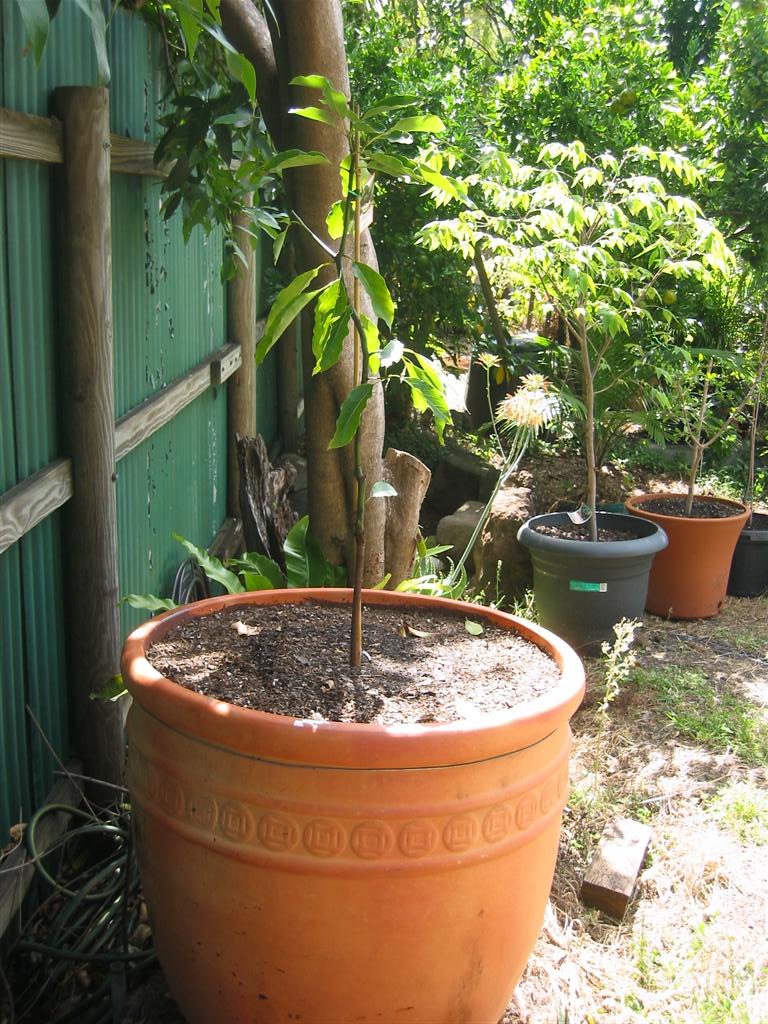
The Secondo which is a staff favourite at Daleys is pictured above. I am also growing in an identical pot the Wurtz Dwarf Avocado Tree (very top photo). My bet is that the Secondo will out perform the Wurtz so I think it is a good controlled test. The Secondo and Wurtz are both A-Type varieties and although the Secondo is known to set fruit with no other B-Type avocado in sight you can get an even bigger crop by growing B-Type avocado close by. My choice will be the Sharwill over the Fuete because the Fuete sometimes fruits every second year and the Sharwill every year. The Sharwill usually is flowering when the Secondo is which should enourage good pollination.
My other choice of Avocado which I won't be growing but will someday is the Reed Avocado which is out of this world in size. You could fit 3 Hass avocados inside one Reed and the taste although a little different is still just as good I think.
Avocado Ripening Tip: Place it in a paper bag with a banana or apple and it will ripen quicker.
Another point is that avocado varities don't all ripen at the same time. And like mandarine trees for example where you get early, mid and late varieties by getting a few different varitites of avocados growing you can have avocados ripening for most of the year and what could be better than that? I guess after just planting these avocados I am a bit obssessed with them at the moment.
 With all the pitfalls Growing Avocado Trees in the backyard is still a favourite of Queenslanders and NSW people with Victorians usually growing the Bacon Avocado Tree which can handle their colder climates.
As kids we had a seedling Avocado Tree which took 15 years before it fruited and then straight after that with a big downpoor it died. This is why Grafted Avocados are best. You can usually get fruit within 3-4 years and the Secondo Avocado Tree is known to give crops in 2 years.
Now I mentioned that they are "fuss pots" and that is why I am not just using any pot but the King of all pots so I can give their root system maximum drainage and room to spread it's roots. Avocados like water going past their roots but it can be fatal if their roots are immersed in water.
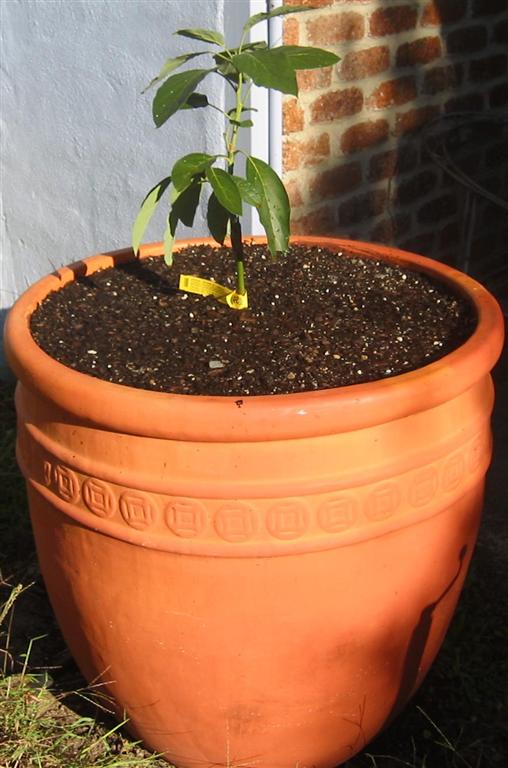
The Secondo which is a staff favourite at Daleys is pictured above. I am also growing in an identical pot the Wurtz Dwarf Avocado Tree (very top photo). My bet is that the Secondo will out perform the Wurtz so I think it is a good controlled test. The Secondo and Wurtz are both A-Type varieties and although the Secondo is known to set fruit with no other B-Type avocado in sight you can get an even bigger crop by growing B-Type avocado close by. My choice will be the Sharwill over the Fuete because the Fuete sometimes fruits every second year and the Sharwill every year. The Sharwill usually is flowering when the Secondo is which should enourage good pollination.
My other choice of Avocado which I won't be growing but will someday is the Reed Avocado which is out of this world in size. You could fit 3 Hass avocados inside one Reed and the taste although a little different is still just as good I think.
Avocado Ripening Tip: Place it in a paper bag with a banana or apple and it will ripen quicker.
Another point is that avocado varities don't all ripen at the same time. And like mandarine trees for example where you get early, mid and late varieties by getting a few different varitites of avocados growing you can have avocados ripening for most of the year and what could be better than that? I guess after just planting these avocados I am a bit obssessed with them at the moment.
Subscribe to:
Posts (Atom)