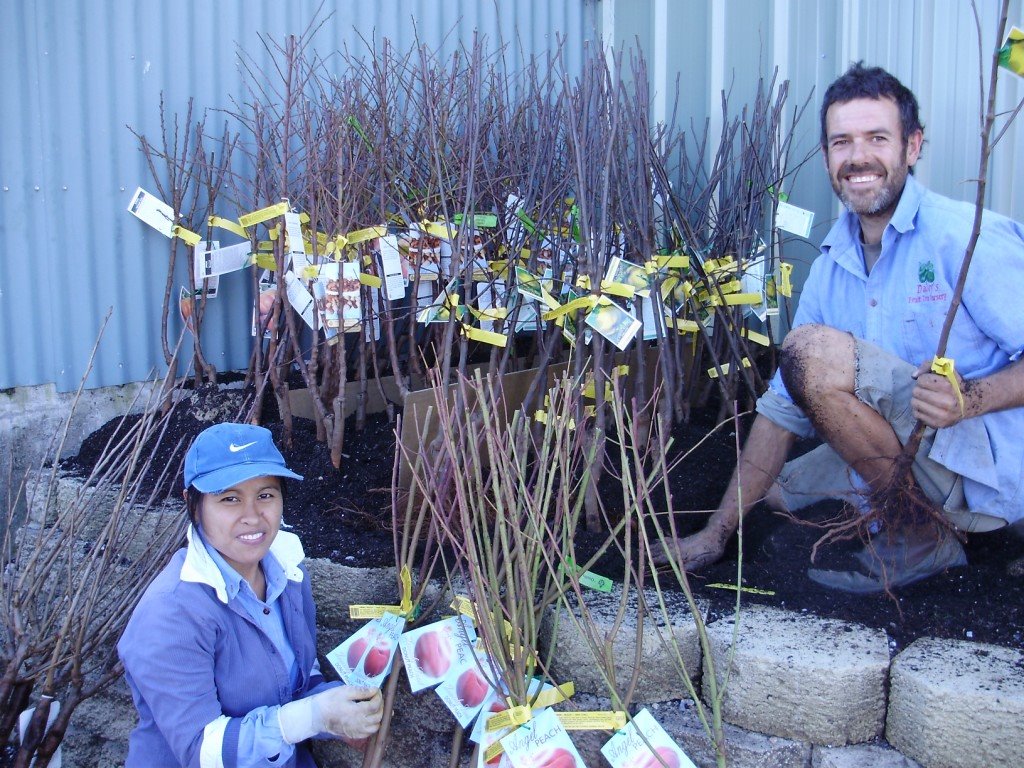
When Buying Bare Root Fruit Trees from Daleys Fruit Tree Nursery you need to make sure that you remove the fruit in the first 2 years. Some people think it's a choice to make but to have a healthy fruit tree you really need to do this so you create a health fruit tree. Grafted fruit trees do not go through all the stages that a seedling tree go through particularly the juvenile stage where seedling trees do not fruit but develop. Grafted Fruit Trees will want to flower and fruit straight away. It is therefore recommended to remove all the fruit in these first years.
Showing posts with label bare root. Show all posts
Video Bare Root Fruit Trees
See what Bare Root Fruit Trees look like, how they are transported and the specific points on these "Sticks" that you need to understand. A whole orchard can be created in 1 compact order.
Detailed/Pictured List of Bare Root Plants that will be sent in June/July
Compact Page with every Bare Root Plant
In the video we show you how they save space making them perfect for mail order and offer 50% off freight compared to buying these plants as potted plants outside of Winter.
Packaging Bare Root Fruit Trees
![]() |
| Dave Packaging Bare Root Fruit Trees |
Dave just packaged up these bare root fruit trees while they are dormant. This one order will make a lovely fruit orchard providing fruit and nuts for the next 50+ years and will arrive ready to plant at our very lovely customers front door shortly.
2x Grape Vines
4x Asparagus
2x Gooseberry
#daleysfruit #fruittrees #bareroot
Persimmon Fruit Trees - Choose Astringent or Non Astringent?
![]() |
| Persimmon Fruit Trees - Astringent or Non Astringent |
Can you write in the comments "Astringent" or "Non Astringent" so we can see which ones you like best?
If i had to choose I enjoy Astringent Persimmons. The Fruit must be perfectly ripe and almost like Jelly before you can eat it. If you get the timing wrong you will be spitting it out for 1 minute and the sandpaper taste lingers for 5 minutes. But when they are perfectly ripe they are amazing, will stop you from thinking about everything else and just enjoy the moment. Granted eating them is impractical they can fall apart and are sticky and gooey and there is only a very small window where you can eat them but the taste is amazing. Transporting them when they are ready to eat this can be difficult. When growing your own you can control some of these problems.
Non Astringent persimmons however are practical, easy to transport and can be eaten like an apple and even when hard they still taste good.
Bare Root Fruit Trees
Bare Root Fruit Trees - Ready Now
Bare root trees are deciduous trees that are sold during the winter when they are dormant. They are grown in the ground or pots during the growing season and once they drop their leaves they are lifted, pruned and prepared for shipping.
How are Bare Root Trees Shipped?
Bare root trees are shipped free of soil or pots. They can be bundled together for shipping which means that freight is very economical, especially for anyone purchasing a group of trees as they can be packed together into one compact package. Their roots are protected during transport with some moist packing material, this prevents them from drying out which is very important.
Unboxing my Bare Root Fruit Trees?
It is important to plant your bare rooted trees as soon as possible, if you do not have your site prepared you may choose to pot your tree until you have the ground prepared, do this as soon as you receive it into a good quality potting mix. Despite the trees being dormant they still need to be cared for and it is important to make sure that the roots of your trees do not dry out, don't leave them lying exposed in the sun. You may also heal in your trees into a garden bed which involves covering the roots with soil until you have the site prepared for planting. Don't over water your bare root trees while they are dormant.
How do I plant my Bare Root Trees?
Dig a hole that is at least twice the size of the root ball, remember do not leave your bare rooted tree lying in the sun while you are busy digging the hole. Free drainage is vital for the health of all trees so make sure that the soils is rich, fertile and drains freely. If necessary you may need to add some compost or mound your planting site if you have heavy clay soil. It is important that you do not plant the tree any deeper that it was originally grown in the soil, look for a change in colour at the base of the stem, this will indicate where the previous soil line has been, plant it to the same depth, never deeper. Spread the roots out in a natural fashion, if necessary a little mound of soil in the centre of your hole will help you to hold the tree at the correct planting height. Back fill with soil. Gently shaking the trunk of your tree as you are back filling will help the soil to fill between the roots. Water in well, this removes any pockets of air and settles the soil around the roots. If the tree feels loose in the ground, place two stakes in the ground either side of your tree well away the root zone and loosely tie the tree to the stakes with a soft cloth tie in a figure of 8 around the trunk of your tree. Mulch well with a mix of organic mulch like lucerne hay, barley straw, grass clippings, small amounts of wood chip of different sizes and/or pruning materials from your garden. This will conserve moisture, regulate soil temperature, break down and feed your tree and the soil. Remember it needs to be kept away from the trunk of the tree. Do not fertilize your tree until it begins to break dormancy in the spring time.
How long do Bare Root Fruit Trees take to fruit
Grafted trees can flowers and fruit in their first year however we do recommend that you remove all the fruit from your new trees for the first year, this will allow your trees to establish into strong and healthy trees before you let them fruit. If you leave them to fruit in their first year they will put all their energy into the fruit at the expense of roots and shoots which can stress and stunt the growth of your tree.
Why Plant Bare Root Trees
Bare root trees are easy to transport and plant and they will surprise you in the spring when they push off with a vigorous flush of new growth. They are extremely satisfying to plant and grow but the best thing about them is they will reward all your efforts with a bounty of home grown fruit for years to come.
Be inspired and venture out into your garden to plant a fruit tree today.
- View All Bare Root Fruit Trees ( Ready for Sale )
Bare root trees are deciduous trees that are sold during the winter when they are dormant. They are grown in the ground or pots during the growing season and once they drop their leaves they are lifted, pruned and prepared for shipping.
How are Bare Root Trees Shipped?
Bare root trees are shipped free of soil or pots. They can be bundled together for shipping which means that freight is very economical, especially for anyone purchasing a group of trees as they can be packed together into one compact package. Their roots are protected during transport with some moist packing material, this prevents them from drying out which is very important.
Unboxing my Bare Root Fruit Trees?
It is important to plant your bare rooted trees as soon as possible, if you do not have your site prepared you may choose to pot your tree until you have the ground prepared, do this as soon as you receive it into a good quality potting mix. Despite the trees being dormant they still need to be cared for and it is important to make sure that the roots of your trees do not dry out, don't leave them lying exposed in the sun. You may also heal in your trees into a garden bed which involves covering the roots with soil until you have the site prepared for planting. Don't over water your bare root trees while they are dormant.
How do I plant my Bare Root Trees?
Dig a hole that is at least twice the size of the root ball, remember do not leave your bare rooted tree lying in the sun while you are busy digging the hole. Free drainage is vital for the health of all trees so make sure that the soils is rich, fertile and drains freely. If necessary you may need to add some compost or mound your planting site if you have heavy clay soil. It is important that you do not plant the tree any deeper that it was originally grown in the soil, look for a change in colour at the base of the stem, this will indicate where the previous soil line has been, plant it to the same depth, never deeper. Spread the roots out in a natural fashion, if necessary a little mound of soil in the centre of your hole will help you to hold the tree at the correct planting height. Back fill with soil. Gently shaking the trunk of your tree as you are back filling will help the soil to fill between the roots. Water in well, this removes any pockets of air and settles the soil around the roots. If the tree feels loose in the ground, place two stakes in the ground either side of your tree well away the root zone and loosely tie the tree to the stakes with a soft cloth tie in a figure of 8 around the trunk of your tree. Mulch well with a mix of organic mulch like lucerne hay, barley straw, grass clippings, small amounts of wood chip of different sizes and/or pruning materials from your garden. This will conserve moisture, regulate soil temperature, break down and feed your tree and the soil. Remember it needs to be kept away from the trunk of the tree. Do not fertilize your tree until it begins to break dormancy in the spring time.
How long do Bare Root Fruit Trees take to fruit
Grafted trees can flowers and fruit in their first year however we do recommend that you remove all the fruit from your new trees for the first year, this will allow your trees to establish into strong and healthy trees before you let them fruit. If you leave them to fruit in their first year they will put all their energy into the fruit at the expense of roots and shoots which can stress and stunt the growth of your tree.
Why Plant Bare Root Trees
Bare root trees are easy to transport and plant and they will surprise you in the spring when they push off with a vigorous flush of new growth. They are extremely satisfying to plant and grow but the best thing about them is they will reward all your efforts with a bounty of home grown fruit for years to come.
Be inspired and venture out into your garden to plant a fruit tree today.
Chill Hours for Fruit Trees - Calculation using BOM Australia
Many of our Bare Root Fruit Trees that we sell in June and July will not give you fruit unless you get the right Chill Hours in Winter.
For Example the Angel Peach Tree has two different varieties. A High Chill and a Low Chill Variety. If you live in Cairns and buy the High Chill Angel Peach you will not get any fruit.
Definition of Chill Hours for Fruit Trees
Time spent below approximately 7 degrees.
High Chill Fruit Trees are 650+ Hours
Medium Chill Fruit Trees are 450-650 Hours
Low Chill Fruit Trees are 150-450 Hours
Silly Question: Do I go outside every day of the year with a stopwatch and a thermometer?
Answer: You could, but it is obviously a very funny waste of time
Calculating Chill Hours at your Address in Australia
Just to make it clear straight up plants are alive and as such there is no exact science for the amount of chill hours a certain fruit tree needs, it is always going to be approximate.
In Australia we are privileged to get the website for the Bureau of Meteorology and this allows us to find the Average temperature of the coldest month. We then use this temperature to Estimate the chill hours.
Step 1
Go to the the BOMS Climate Data Online
Step 2
Data about: Temperature
Type of Data: Monthly
Select: Mean Minimum Temperature
Weather Station: [Type your own Suburb here]
Nearest Bureau: Closest to your address
Click: Get Data
Step 3: This will give you a view of the Monthly Mean Minimum Temperature for your suburb.
Step 4: Scroll down the page to the last year of information and select the Lowest Monthly Mean Temperature which is usually in July but sometimes June.
Step 6: While you are looking at this number take note of the previous year minimums. Perhaps this year was an exception and you might like to use another years minimum. So in this case I am using 7.2 degrees.
Step 7: Now we want to find the Mean Maximum Temperature that matches this figure from Step 6 So I need to remember 2011 and the month of July. ( yours might be June )
Go back to the BOMS Climate Data Online ( Likely already opened ) But this time select:
Data about: Temperature
Type of Data: Monthly
Select: Mean Maximum Temperature
Weather Station: [Type your own Suburb here]
Nearest Bureau: Closest to your address
Click: Get Data
Step 8: Scroll Down to the latest year and select the temperature for the corresponding month to step 6.
In my example it is 21.1 degrees.
Step 9: Now we want to add the Mean Minimum Temperature and the Mean Maximum Temperature together and divide by 2 to get the average. In this case (7.2+21.1)/2=14.15
Step 10
Now we try and fit this number into the Chill Hours Table below. The Chill hours in this table are commonly used to describe Fruit Tree Chill Hours and you will see them across the Daleys Fruit Tree Website in descriptions, across the web and fruit tree reference books.
Chill Hours Average Temperature for coldest month
0 19.7 degrees (No Chill)
300 15.5 degrees (Low Chill)
330 15.3 degrees (Low Chill)
450 14 degrees (Medium Chill)
500 13.6 degrees (Medium Chill)
520 13.1 degrees (Medium Chill)
600 12.7 degrees (Medium to High Chill)
800 10.2 degrees (High Chill)
1100 7.9 degrees (High Chill)
1250 0 degrees (Very High Chill)
So for the case used which was 14.15 degrees we can approximate this to 330-450 Chill Hours or Low Chill. If a plant that requires Medium Chill was purchased it might produce fruit some years when the winter is colder but not others when the winter is warmer.
Things to Consider
Remember how we said you could take a stopwatch and a thermometer outside? Well here is your chance. The weather station that you chose in step 2 is very unlikely to be exactly the same as your backyard orchard. So what you can do is every morning just before sunrise record your backyard orchards temperature. Then go to the BOMs Climate Data Online and fill out the form for Daily Data by selecting:
Data about: Temperature
Type of Data: Daily
Select: Minimum Temperature
Weather Station: [Type your own Suburb here]
Nearest Bureau: Closest to your address
Click: Get Data
Now if the reading you got from the thermometer in you backyard orchard is lower then the BOMs minimum temperature you can assume that you will get slightly more chill hours then the calculation you got by using the above steps. This means that you "might" be able to get fruit with a higher chill variety.
Conclusion and Final Note
If you are reading this it is likely that you are a fruit lover who wants to test the boundaries of what is possible. At Daleys we have come to accept that people in Victoria (Australia's High Chill Country) want to grow Tropical Fruit Trees and people in Rochampton (Australia's Low Chill Country) want to grow high chill temperate fruit trees even though we don't like your chances of getting fruit. However some of you have many examples where you have succeeded. The Daleys Fruit Tree Forum has many of these stories.
If you are in a Low Chill environment and want to grow fruits such as Blueberries, Apples, Plums and even Cherries then we often have varieties that are Low Chill. For example the Acerola Cherry Tree crops in Low Chill Climates.
Growing High Chill Fruit Trees in a Low Chill Climate
Now if you know that you don't get the right chill hours and are still super keen to grow high chill plants my only other suggestion is to grow your plants in pots and get yourself a super big freezer to put them in during winter. JOKING!!!!!!!!!!
For Example the Angel Peach Tree has two different varieties. A High Chill and a Low Chill Variety. If you live in Cairns and buy the High Chill Angel Peach you will not get any fruit.
Definition of Chill Hours for Fruit Trees
Time spent below approximately 7 degrees.
High Chill Fruit Trees are 650+ Hours
Medium Chill Fruit Trees are 450-650 Hours
Low Chill Fruit Trees are 150-450 Hours
Silly Question: Do I go outside every day of the year with a stopwatch and a thermometer?
Answer: You could, but it is obviously a very funny waste of time
Calculating Chill Hours at your Address in Australia
Just to make it clear straight up plants are alive and as such there is no exact science for the amount of chill hours a certain fruit tree needs, it is always going to be approximate.
In Australia we are privileged to get the website for the Bureau of Meteorology and this allows us to find the Average temperature of the coldest month. We then use this temperature to Estimate the chill hours.
Step 1
Go to the the BOMS Climate Data Online
Step 2
Data about: Temperature
Type of Data: Monthly
Select: Mean Minimum Temperature
Weather Station: [Type your own Suburb here]
Nearest Bureau: Closest to your address
Click: Get Data
Step 3: This will give you a view of the Monthly Mean Minimum Temperature for your suburb.
Step 4: Scroll down the page to the last year of information and select the Lowest Monthly Mean Temperature which is usually in July but sometimes June.
Step 6: While you are looking at this number take note of the previous year minimums. Perhaps this year was an exception and you might like to use another years minimum. So in this case I am using 7.2 degrees.
Step 7: Now we want to find the Mean Maximum Temperature that matches this figure from Step 6 So I need to remember 2011 and the month of July. ( yours might be June )
Go back to the BOMS Climate Data Online ( Likely already opened ) But this time select:
Data about: Temperature
Type of Data: Monthly
Select: Mean Maximum Temperature
Weather Station: [Type your own Suburb here]
Nearest Bureau: Closest to your address
Click: Get Data
Step 8: Scroll Down to the latest year and select the temperature for the corresponding month to step 6.
In my example it is 21.1 degrees.
Step 9: Now we want to add the Mean Minimum Temperature and the Mean Maximum Temperature together and divide by 2 to get the average. In this case (7.2+21.1)/2=14.15
Step 10
Now we try and fit this number into the Chill Hours Table below. The Chill hours in this table are commonly used to describe Fruit Tree Chill Hours and you will see them across the Daleys Fruit Tree Website in descriptions, across the web and fruit tree reference books.
Chill Hours Average Temperature for coldest month
0 19.7 degrees (No Chill)
300 15.5 degrees (Low Chill)
330 15.3 degrees (Low Chill)
450 14 degrees (Medium Chill)
500 13.6 degrees (Medium Chill)
520 13.1 degrees (Medium Chill)
600 12.7 degrees (Medium to High Chill)
800 10.2 degrees (High Chill)
1100 7.9 degrees (High Chill)
1250 0 degrees (Very High Chill)
So for the case used which was 14.15 degrees we can approximate this to 330-450 Chill Hours or Low Chill. If a plant that requires Medium Chill was purchased it might produce fruit some years when the winter is colder but not others when the winter is warmer.
Things to Consider
Remember how we said you could take a stopwatch and a thermometer outside? Well here is your chance. The weather station that you chose in step 2 is very unlikely to be exactly the same as your backyard orchard. So what you can do is every morning just before sunrise record your backyard orchards temperature. Then go to the BOMs Climate Data Online and fill out the form for Daily Data by selecting:
Data about: Temperature
Type of Data: Daily
Select: Minimum Temperature
Weather Station: [Type your own Suburb here]
Nearest Bureau: Closest to your address
Click: Get Data
Now if the reading you got from the thermometer in you backyard orchard is lower then the BOMs minimum temperature you can assume that you will get slightly more chill hours then the calculation you got by using the above steps. This means that you "might" be able to get fruit with a higher chill variety.
Conclusion and Final Note
If you are reading this it is likely that you are a fruit lover who wants to test the boundaries of what is possible. At Daleys we have come to accept that people in Victoria (Australia's High Chill Country) want to grow Tropical Fruit Trees and people in Rochampton (Australia's Low Chill Country) want to grow high chill temperate fruit trees even though we don't like your chances of getting fruit. However some of you have many examples where you have succeeded. The Daleys Fruit Tree Forum has many of these stories.
If you are in a Low Chill environment and want to grow fruits such as Blueberries, Apples, Plums and even Cherries then we often have varieties that are Low Chill. For example the Acerola Cherry Tree crops in Low Chill Climates.
Growing High Chill Fruit Trees in a Low Chill Climate
Now if you know that you don't get the right chill hours and are still super keen to grow high chill plants my only other suggestion is to grow your plants in pots and get yourself a super big freezer to put them in during winter. JOKING!!!!!!!!!!
Bare Root Fruit Trees 2012 - The Problem and Solution for Juicy Backyards
Surprisingly when some fruit trees look like sticks this is the best time for planting. Cherries, Apricots, Raspberries, Almonds, Peaches are often sold as Bare Root Plants.
The Problem
"Dear Daleys Nursery: You have one Bare Root Fruit Tree I want but the other one won't be ready until next year. What Can I do?"
The Solution
We have a special Bare Root Page that allows you to order the stock now but receive them in June/July. YES you can purchase anything off our IN STOCK PLANT LIST. Good news is they are sent in one go saving you freight costs.
Bare Root Stock to PRE-ORDER | PLANTS IN STOCK NOW
About Bare Root Fruit Trees
Too Simple... Many people think of Fruit Trees with Luscious green foliage and bright fruit LIKE THIS...
(Click If Image Does not Load)BUT... Apricots, Cherries, Persimmons, Plums and Almonds will never produce fruit unless they appear to die LIKE THIS...

WHY... For the colder climates of Australia during Winter the temperature drops below 6 degrees. Many amazing fruit trees will only grow in these colder climates because they need these Chill Hours so that come spring they will BLOSSOM, FLOWER AND FRUIT LIKE THIS...

Bare Root Stock Arrived 2010
Popular Bare Root Stock includes Apricots, Apples, Peaches, Quinces, Almonds, Plumcotts, Nectarines, Mulberries.
Bare Root Stock 2009 Just Arrived
We are very excited because our Bare Root Stock has just arrived and is ready to be mail ordered to homes across Australia.
Winter is a great time for the Mail Order of Bare Root Fruit Trees.
Some Bare Root Fruit Trees Ready for Sale
Quince Tree Bare Root
Apricot Tree Bare Root
Dwarf Apple Tree Bare Root
Peach Tree Bare Root
Low chill Dwarf Sunset Peach Bare Root NEW
Nectarine Trees Bare Root NEW
Almond Trees Bare Root
Grape Vines Bare Root
Subscribe to:
Posts (Atom)


.jpg)